Kia ora koutou
In this Pānui, I’m pleased to share some highlights from our newly published 2024/25 Annual Report, marking a year of ongoing evolution for New Zealand’s broadcasting standards system.
The past year saw a fall in formal complaint numbers, and only eight decisions (9.5% of all rulings) finding breaches of standards – well below historical rates. This reflects both the maturity of our co-regulatory system and the way audiences are shifting to new platforms.
At the same time, public trust in the BSA rose to a record high, with the Authority among the most improved agencies in the
2025 Verian Public Sector Reputation Indexopen_in_new. We’re grateful for broadcasters’ ongoing commitment to high standards, which underpins confidence in our co-regulatory system.
In the past year we’ve also worked to make our complaints process more accessible, with the likes of new plain-language explainer videos and website improvements.
Thank you for the role you’ve played over the past year through your work with us as broadcasters and stakeholders.
As in successive annual reports going back well over a decade, we again point to the outdated nature of the 1989 Broadcasting Act the BSA operates under.
This has come into focus with the BSA recently accepting, for the first time, a formal complaint about an online broadcaster. We did so under a
published BSA policyopen_in_new dating to 2020.
Far from conducting a ‘power grab’, we have no intention of trying to act outside the Authority’s existing reach. This is determined by the Broadcasting Act, and our view is that online livestreamed content of the nature complained about falls within our jurisdiction.
Far from attacking free speech, as some have claimed, freedom of expression is at the heart of every BSA decision – and, as reflected in the past year’s figures, only in a small number of decisions is the risk of harm deemed to outweigh this fundamental right.
We can only investigate if a complaint is made to us, and the Broadcasting Act says we have to take complaints if they meet the requirements.
We are operating under legislation that is now 36 years old and carrying out our duties as a responsible independent regulator in applying the legislation as it stands to the current environment.
But, as we’ve been saying with increasing urgency for over 15 years, the clearest and best solution lies in legislative reform of media regulation.
The Government this year released proposals that would deliver modern, platform-neutral and system-level regulation of professional media. We welcomed this and look forward to seeing proposals progressed.
You can see our full Annual Report on the
BSA websiteopen_in_new.
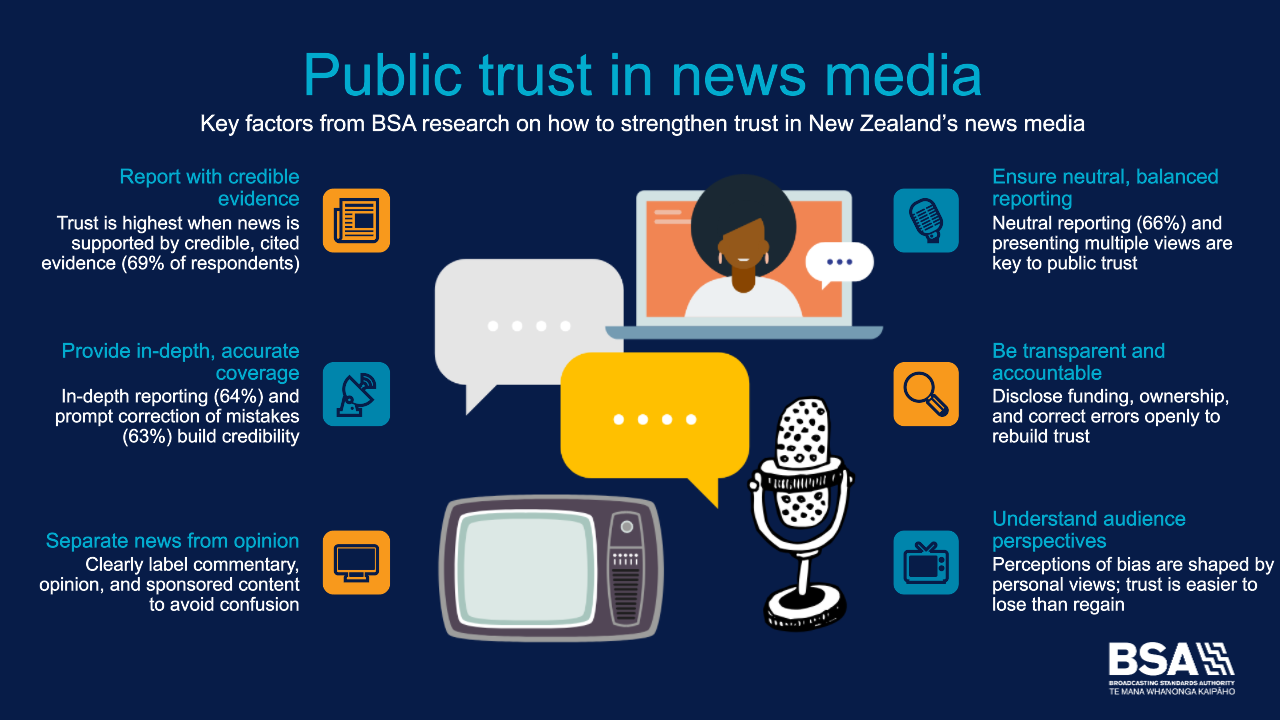
Trust in news media research New Zealanders are highly engaged with news media and have more trust in New Zealand sources and those that rely on evidence, report in-depth, and are quick to fix – and acknowledge – mistakes when they happen.
These are among findings in a new survey for the BSA exploring public expectations around news content and factors that may help improve trust in news media.
Freedom from bias also features as an important factor, but perceptions of ‘bias’ are coloured by audiences’ personal views – and how well they feel their own views are reflected.
As a complaints body, we see this with complainants from all parts of the political spectrum alleging a lack of fairness, balance or accuracy in content with which they disagree but, objectively, is found to be in line with established standards.
 open_in_new[Click on infographic to see full size]
The BSA’s research suggests trust is easier to lose than to regain. Media organisations are responding, prioritising transparency, accountability, and clear editorial boundaries. Our findings offer further helpful guidance. The BSA will also use the findings to inform decisions and any future updates to the Code of Broadcasting Standards.
The survey report can be seen on the
BSA websiteopen_in_new.
AppointmentsWe were delighted by the
recent announcementopen_in_new from Manatū Taonga Ministry for Culture and Heritage, that our Chair Susie Staley has been reappointed for a further three-year term. This followed the
announcementopen_in_new earlier this year of the reappointment of board member John Gillespie, and the appointment of a new member Karyn Fenton-Ellis. Members are appointed by the Governor-General on the recommendation of the Minister for Media and Communications.
Ngā mihi mahana
Stacey Wood
Chief Executive